
How to Choose the Right Size Barn Door for Your Doorway
How to Choose the Right Size Barn Door for Your Doorway
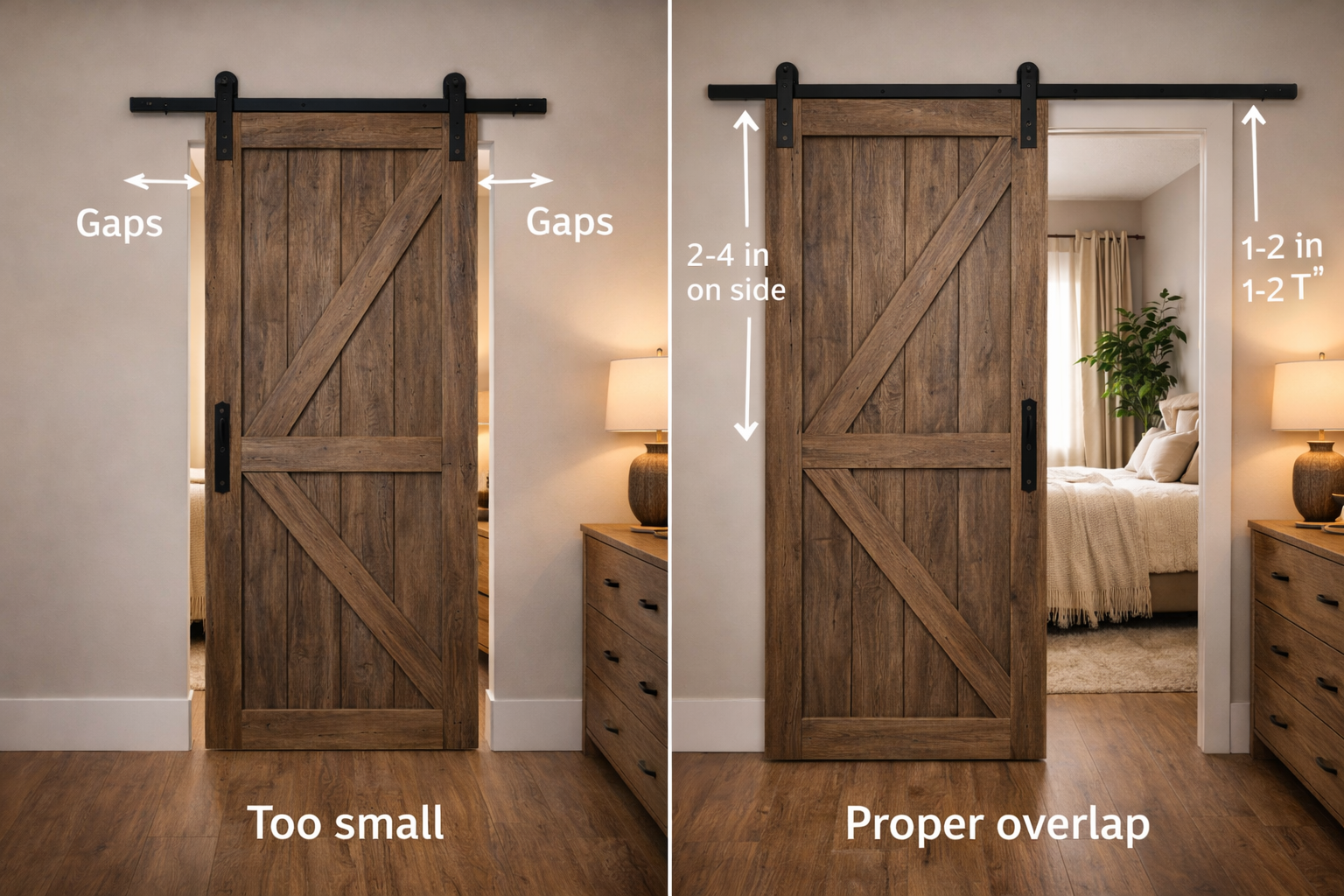
To choose the right barn door size, your door should be at least 2–4 inches wider than your doorway on each side and 1–2 inches taller than the opening. This ensures full coverage, privacy, and smooth sliding.
You find a barn door you like.
You order it.
You install it… and suddenly realize:
👉 It doesn’t fully cover the doorway
👉 Light leaks through the sides
👉 It just looks… off
This is one of the most common mistakes people make with barn doors.
And it all comes down to sizing.
The good news?
Once you understand how barn door sizing works, it’s actually very simple to get right the first time.
Why Barn Door Size Matters
Unlike traditional doors, barn doors don’t sit inside a frame.
They sit on the outside of the wall, sliding across the opening.
That means the door needs to overlap the doorway, not match it exactly.
If it doesn’t:
Gaps will be visible
Privacy is reduced
The door won’t function properly
Step 1: Measure Your Doorway Opening
Start with the basics.
Measure:
Width of the opening (left to right)
Height of the opening (floor to top of frame)
Example:
Opening = 36" wide × 80" tall
Step 2: Add Overlap (This Is Key)
Your barn door should be larger than the opening.
Width Rule
👉 Add 2–4 inches on each side
So for a 36" opening:
Ideal door width = 40"–44"
Height Rule
👉 Add 1–2 inches taller than the opening
So for an 80" opening:
Ideal door height = 81"–82"
Step 3: Check Wall Space for Sliding
This is the step many people forget.
Your door needs space to slide open.
👉 You need at least the full width of the door available on one side of the doorway.
Example:
42" door → need ~42" of wall space
Step 4: Consider Floor Clearance
Barn doors don’t touch the floor.
Typical gap:
½ inch to 1 inch above the floor
This allows smooth sliding without dragging.
Common Sizing Mistakes
Choosing Same Size as Doorway
This leads to:
Gaps
Poor coverage
Less privacy
Not Checking Wall Space
You install the door… and it can’t fully open.
Ignoring Hardware Height
Track systems add extra height above the door.
Make sure you have enough space above the doorway.
The Most Practical Approach
Most homeowners simplify the process by choosing pre-sized barn door kits designed for standard openings.
These kits:
Include properly sized doors
Match hardware automatically
Remove guesswork
Product Integration (Soft Recommendation)
For an easier installation process, many people choose solid wood barn door kits with included hardware.
These kits are designed with:
Standard sizing options
Compatible track systems
Ready-to-install components
If you’re comparing options, browsing a collection of barn door kits can help you find the right size for your doorway.
You can also explore a related guide on where to buy solid wood barn doors with hardware included to simplify your search.
Visual Example: Correct vs Incorrect Sizing
Incorrect Size
Door matches opening
Gaps on sides
Light passes through
Correct Size
Door overlaps opening
Full coverage
Clean, finished look
Standard Barn Door Sizes (Quick Reference)
Opening WidthRecommended Door Width30"34"–38"32"36"–40"36"40"–44"48"52"–56"
Single vs Double Barn Doors
Single Door
Best for standard doorways
Slides one direction
Double Doors
Best for wide openings
Meet in the middle
Frequently Asked Questions
How much bigger should a barn door be than the opening?
Typically 2–4 inches wider on each side and 1–2 inches taller.
Can a barn door be too big?
Yes. Too large can look unbalanced and may not fit your wall space.
Do barn doors need to cover trim?
Yes. They should fully cover the doorway and trim for best results.
What if I don’t have enough wall space?
You may need a double door or alternative solution.
Are standard sizes reliable?
Yes. Most are designed to fit common doorway dimensions.
Do I need professional installation?
Not usually. Most kits are designed for DIY installation.
Conclusion
Choosing the right barn door size isn’t complicated—but it is critical.
The key is understanding that barn doors need to overlap the doorway, not match it.
By measuring correctly, allowing for overlap, and checking your wall space, you can avoid common mistakes and get a door that looks and functions perfectly.
If you want to simplify the process, choosing a properly sized barn door kit can make installation much easier and ensure everything fits as it should.
