
How to Create a Warm Side and Cool Side in a PVC Enclosure
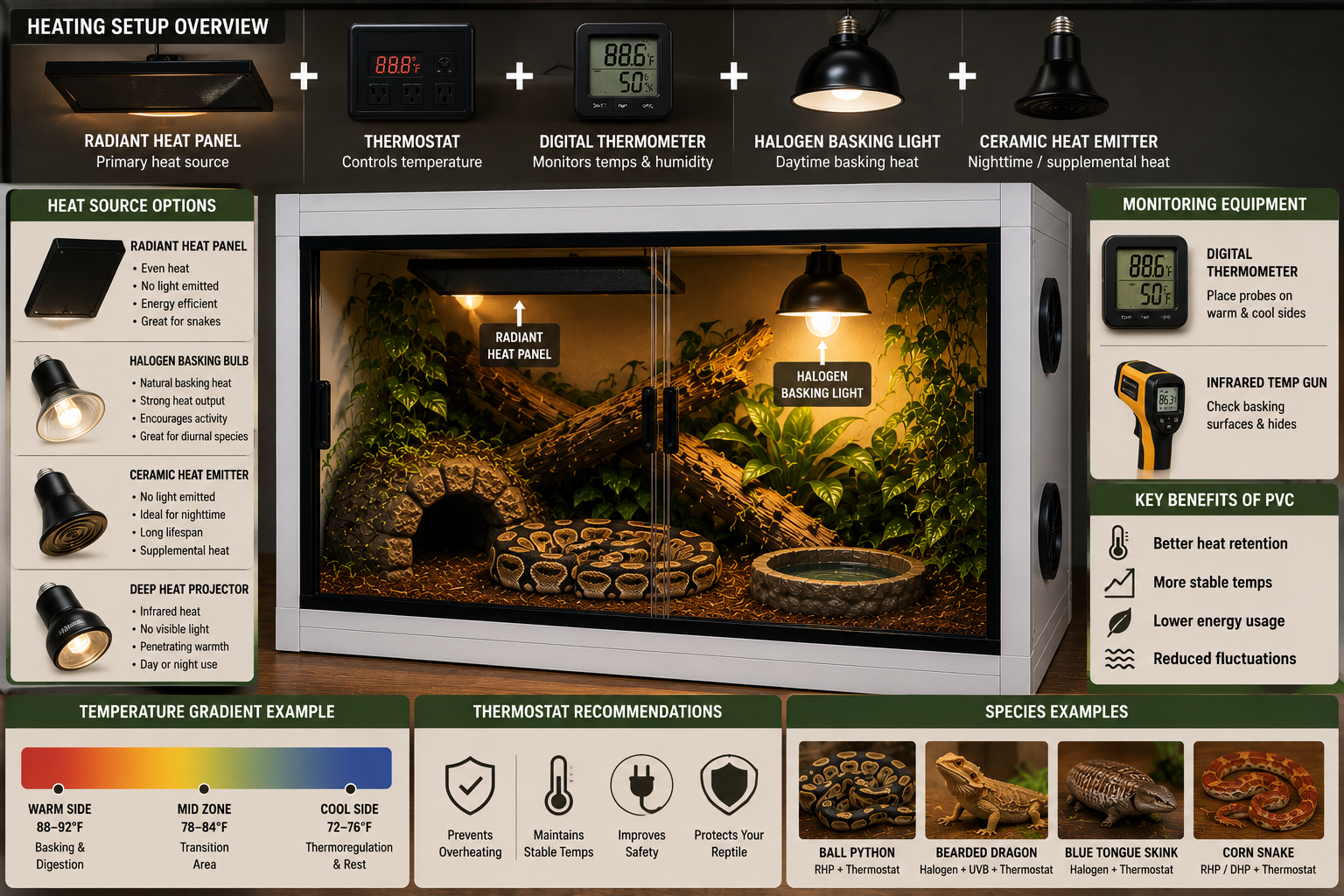
How to Create a Warm Side and Cool Side in a PVC Enclosure
To create a warm side and cool side in a PVC reptile enclosure, place your primary heat source at one end of the enclosure and allow temperatures to gradually decrease toward the opposite end. This creates a temperature gradient that lets your reptile move between warmer and cooler areas as needed.
A proper thermal gradient is one of the most important parts of reptile husbandry because reptiles rely on environmental temperatures to regulate their bodies.
What Is a Temperature Gradient?
A temperature gradient is the range of temperatures available within an enclosure.
Instead of heating the entire habitat evenly, one side is warmer while the other remains cooler.
This allows reptiles to:
Regulate body temperature
Aid digestion
Control activity levels
Choose preferred resting spots
Display natural behaviors
Without a temperature gradient, reptiles lose the ability to thermoregulate effectively.
Why PVC Enclosures Make Gradients Easier
PVC naturally retains heat better than glass.
Benefits include:
Better insulation
Reduced heat loss
More stable temperatures
Easier environmental control
Because PVC holds heat efficiently, it becomes easier to maintain distinct warm and cool zones.
Step 1: Place the Heat Source on One Side
The most important rule is simple:
Never place heating equipment in the center of the enclosure if your goal is a strong temperature gradient.
Instead, position the heat source toward one end.
Common heating options include:
Radiant heat panels
Halogen basking bulbs
Deep heat projectors
Ceramic heat emitters
The heat source side becomes the warm side.
Step 2: Designate the Opposite End as the Cool Side
The opposite end should remain cooler.
This area allows your reptile to:
Escape excess heat
Rest comfortably
Thermoregulate naturally
Avoid placing additional heating equipment on the cool side unless required for specific species or room conditions.
Step 3: Provide Hides on Both Sides
Every reptile should have access to secure shelters throughout the gradient.
Warm Hide
Located on the heated side.
Useful for:
Digestion
Resting after meals
Basking-adjacent security
Cool Hide
Located on the cooler side.
Useful for:
Resting
Temperature regulation
Reducing stress
This setup gives reptiles options without sacrificing security.
Step 4: Monitor Temperatures Accurately
Never assume temperatures are correct.
Use:
Digital Thermometers
Place probes on:
Warm side
Cool side
Infrared Temperature Gun
Useful for checking:
Basking surfaces
Branches
Hides
Substrate temperatures
Accurate monitoring is essential.
Step 5: Arrange Décor Strategically
Branches, rocks, and hides influence how heat moves through the enclosure.
Consider placing:
Basking platforms near the warm side
Climbing structures in transitional zones
Additional hides throughout the enclosure
This creates multiple microclimates.
Species That Depend on Temperature Gradients
Ball Pythons
Ball Python
Use warm and cool areas throughout the day and night.
Bearded Dragons
Bearded Dragon
Require strong basking zones and cooler retreat areas.
Corn Snakes
Corn Snake
Benefit from multiple temperature options.
Blue Tongue Skinks
Blue-Tongued Skink
Regularly move between warmer and cooler zones.
Common Heating Layouts
4x2x2 PVC Enclosure
A popular setup:
Heat source on the far left or right
Warm hide beneath or near heat source
Cool hide on opposite end
Open transition area between them
This arrangement often creates an effective gradient.
6x2x2 PVC Enclosure
Longer enclosures provide:
Larger gradients
More temperature choices
Additional enrichment opportunities
Many reptiles benefit from the extra flexibility.
Common Mistakes to Avoid
Heating the Entire Enclosure
If every area is the same temperature, the reptile cannot thermoregulate properly.
Using Multiple Heat Sources Incorrectly
Too many heat sources can eliminate the cool side.
Skipping the Cool Hide
A reptile should never have to choose between security and comfort.
Relying on One Thermometer
Temperatures should be measured in multiple locations.
Warm Side vs Cool Side
Warm SideCool SideNear heat sourceOpposite endSupports digestionSupports thermoregulationOften includes basking areaOften includes retreat areaHigher temperaturesLower temperaturesWarm hideCool hide
Both areas are equally important.
Visual Example
A proper thermal gradient allows reptiles to move naturally between warmer and cooler areas throughout the day.
Frequently Asked Questions
Why do reptiles need a warm side and cool side?
Reptiles regulate body temperature by moving between different temperature zones.
Can I heat the entire enclosure evenly?
Generally, no. Most reptiles benefit from having temperature choices.
Where should the heat source be placed?
Usually at one end of the enclosure to create a natural gradient.
Do snakes need a cool side?
Yes. Species such as ball pythons and corn snakes use cooler areas regularly.
Does PVC help maintain temperature gradients?
Yes. PVC's insulation properties make gradients easier to establish and maintain.
Conclusion
Creating a warm side and cool side is one of the most important aspects of setting up a PVC reptile enclosure.
By positioning your heat source at one end, providing hides on both sides, and carefully monitoring temperatures, you can create a stable thermal gradient that allows your reptile to regulate its body temperature naturally.
A properly designed temperature gradient supports healthier behavior, better digestion, and improved overall well-being, making it a cornerstone of successful reptile husbandry.
