
How to Install a Gate Where There’s No Straight Wall
How to Install a Gate Where There’s No Straight Wall
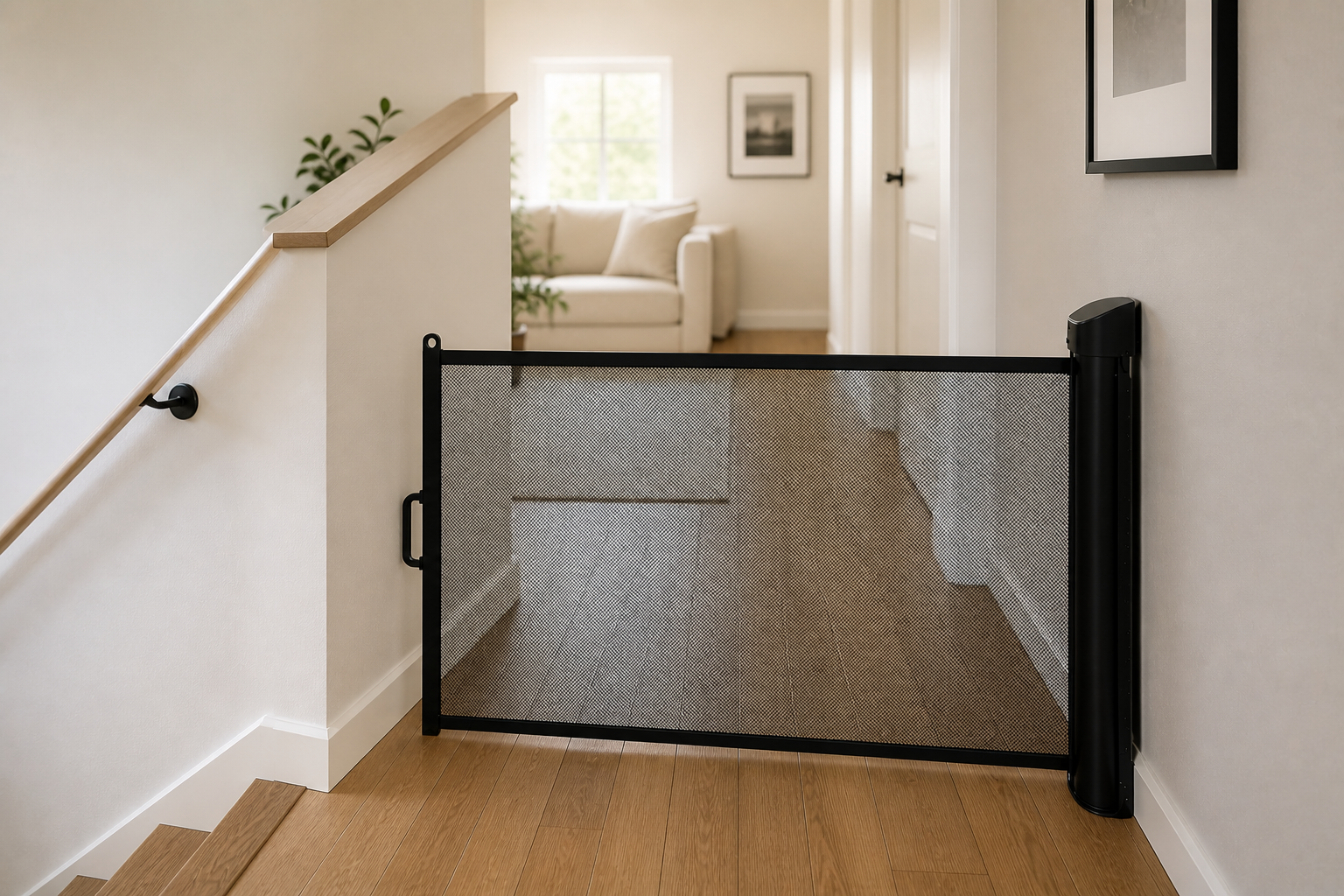
If there’s no straight wall for a traditional baby gate, the best solution is a sliding pocket gate or angled mounting system. These options don’t require perfectly aligned walls and can securely block uneven or open spaces without creating instability or tripping hazards.
Introduction (Problem Hook)
You’re ready to install a gate—but your space refuses to cooperate.
Maybe one side is angled.
Maybe the walls don’t line up.
Or maybe there’s no second wall at all.
Suddenly, what should’ve been a simple installation turns into a frustrating puzzle.
And forcing a standard gate into a space it wasn’t designed for? That usually leads to loose fittings, awkward gaps, or something that just doesn’t feel safe.
So what do you do when there’s no straight wall to install a gate properly?
Why This Problem Happens
Most baby gates are designed for symmetrical, flat openings.
They assume:
Two parallel walls
Even spacing
Flat mounting surfaces
Where It Breaks Down
Real homes don’t always follow those rules.
Common problem setups include:
Angled hallways
Staircases with slanted or offset walls
Open-plan layouts with one exposed side
Uneven doorway frames
Without straight alignment, traditional gates struggle to stay secure.
Common Solutions People Try
1. Forcing a Pressure-Mounted Gate
Pros:
No drilling
Cons:
Unstable on uneven surfaces
Can shift or loosen over time
2. DIY Mounting Blocks
Adding wood pieces to create a flat surface.
Pros:
Makes installation possible
Cons:
Time-consuming
Can look unpolished
May damage walls
3. Custom-Built Barriers
Pros:
Tailored fit
Cons:
Expensive
Requires tools and expertise
4. Skipping the Gate
Pros:
No installation hassle
Cons:
No safety barrier
Related Problems People Also Search
If you’re dealing with this, you’re likely also searching:
How to install a baby gate on uneven walls
Gate solutions for angled openings
Baby gate for stairs with offset walls
How to block a doorway without two walls
Pet gate for irregular spaces
All of these point to the same issue:
👉 Traditional gates aren’t built for irregular layouts.
Why Sliding Gates Work in Uneven Spaces
Sliding gates solve this problem by removing the need for symmetry.
What Makes Them Different
One-sided installation: Only one solid mounting surface required
Flexible alignment: Doesn’t depend on perfectly straight walls
No bottom bar: No awkward positioning or tripping
Side-to-side movement: Works even in angled layouts
Instead of forcing alignment, they adapt to your space.
The Most Practical Long-Term Solution
For uneven or non-traditional layouts, sliding pocket gates are one of the most practical solutions.
They:
Fit spaces where standard gates fail
Provide a secure and stable barrier
Maintain a clean, uncluttered look
Work in both small and wide openings
They’re designed for real homes—not just perfect ones.
Product Integration (Soft Recommendation)
Most people try multiple fixes before realizing the problem isn’t their installation—it’s the gate design.
Once they switch to a sliding system, everything clicks.
No more forcing alignment.
No more unstable fittings.
No more awkward adjustments every time you use it.
You install it once—and it just works.
That’s why many homeowners choose sliding pocket gates for uneven and angled spaces.
If you want to see how they adapt to tricky layouts, explore here:
→ Sliding Pocket Gate Collection
And for specific configurations:
→ Sliding Pocket Gates
Visual Example Section
Imagine a space where:
Your gate fits perfectly—even without straight walls
There are no awkward gaps or unstable mounts
The barrier feels natural, not forced
That’s what the right solution delivers.
Frequently Asked Questions (SEO Gold)
Can you install a baby gate on angled walls?
Yes, but traditional gates struggle. Sliding or flexible mounting solutions work best.
What if I only have one wall for a gate?
Sliding gates are ideal because they only require one mounting surface.
Are pressure-mounted gates safe on uneven walls?
Not usually. They rely on even pressure and may become unstable.
How do you block an irregular doorway?
Using a sliding or custom-fit barrier is the most effective approach.
Do sliding gates work for stairs?
Yes, they are suitable for both staircases and doorways when installed properly.
Can I install a gate without drilling?
Some temporary options exist, but secure solutions typically require mounting.
Conclusion (Soft Call to Action)
Not every home has perfectly straight walls—and trying to force a standard gate into an imperfect space often leads to frustration.
The better approach is using a solution designed to adapt.
If you’re dealing with uneven walls, angled openings, or unconventional layouts, a sliding barrier offers a cleaner, safer, and more reliable option.
Explore your options here:→ Sliding Pocket Gate Collection
