
No Wall Space for a Baby Gate? What to Do
No Wall Space for a Baby Gate? What to Do
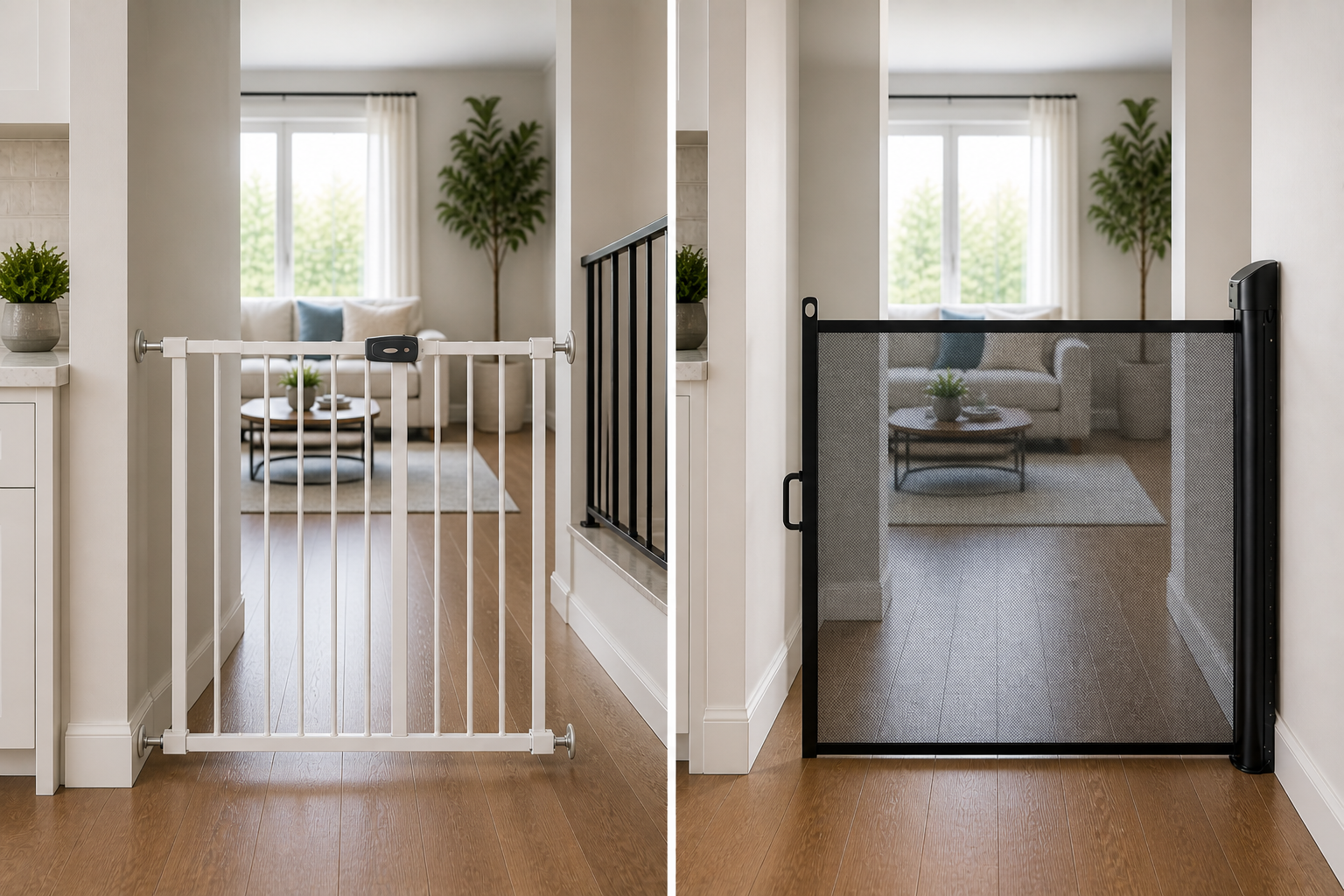
If you don’t have wall space for a baby gate, the safest option is a sliding pocket gate or track-mounted barrier that installs from a single wall. These solutions don’t require two opposing walls and eliminate bottom bars, so you can block access without creating a tripping hazard.
Introduction (Problem Hook)
You’ve found the perfect spot for a baby gate—until you realize there’s nowhere to actually install it.
Maybe one side opens into a room with no wall. Maybe there’s a railing, tile, or cabinet in the way. Or maybe the doorway is too wide or uneven for standard gates to fit.
It’s frustrating, because you still need a safe barrier—but the usual solutions just don’t work in your space.
So what do you do when you don’t have wall space for a baby gate, but still need to block access safely?
Why This Problem Happens
Most baby gates are designed with a very specific setup in mind:
👉 Two solid, parallel walls.
They rely on:
Pressure mounting between flat surfaces
Hardware anchored into studs or drywall
Even spacing for a secure fit
Where It Fails
This setup breaks down in real-world layouts like:
Open-plan living areas
Staircases with one exposed side
Doorways next to cabinets or furniture
Wide or irregular openings
Without proper support on both sides, traditional gates can’t stay secure—or can’t be installed at all.
Common Solutions People Try
When standard gates don’t fit, people usually try to improvise.
1. Creating a “Fake Wall”
Using wood blocks or brackets to build a mounting surface.
Pros:
Makes installation possible
Cons:
Time-consuming
Can damage walls
Often looks unfinished
2. Freestanding Gates
Placed directly on the floor without mounting.
Pros:
No drilling required
Cons:
Not secure
Easy to push over
3. Extra-Wide Adjustable Gates
Designed to span larger openings.
Pros:
Covers more space
Cons:
Still requires support on both sides
Bulky and intrusive
4. Skipping the Gate
Pros:
No installation hassle
Cons:
No protection
Related Problems People Also Search
If this sounds familiar, you’re probably also searching:
Baby gate alternatives without drilling
How to block a doorway with one wall
Gate solutions for open floor plans
Pet gates for uneven openings
Ways to block stairs without bulky gates
All of these point to the same issue:
👉 Traditional gates don’t adapt well to modern layouts.
Why Sliding Gates Work Without Wall Space
Sliding gates approach the problem differently.
Instead of relying on two walls, they use a single mounting point and a sliding track system.
What Makes Them Different
One-sided installation: Only one secure wall needed
No bottom bar: No stepping or tripping
Flexible coverage: Works for wide or awkward openings
Compact storage: Slides neatly out of the way
This makes them one of the few solutions that work even when your space doesn’t fit standard assumptions.
The Most Practical Long-Term Solution
For spaces with limited or uneven wall support, sliding pocket gates offer a reliable and adaptable solution.
They:
Adjust to unconventional layouts
Provide strong, secure barriers
Keep your space visually clean and open
Instead of forcing your space to fit a gate, they’re designed to fit your space.
Product Integration (Soft Recommendation)
Many homeowners discover sliding pocket gates after trying multiple setups that just don’t work.
The biggest difference isn’t just that they fit—it’s how effortless everything feels afterward.
You don’t need to step over anything.
You don’t need to build makeshift supports.
You don’t need to compromise your layout.
When closed, the barrier is secure.
When open, it disappears cleanly along the wall.
That’s why solutions like sliding pocket gates for open layouts and stairways are becoming a go-to option.
If you want to explore how they work in real homes, start here:
→ Sliding Pocket Gate Collection
And for detailed options and finishes:
→ Sliding Pocket Gates
Visual Example Section
Picture a space where:
Your doorway stays open and uncluttered
There’s no bulky frame forcing itself into the layout
Movement feels natural again
Even in tricky setups—like open staircases or wide entrances—the barrier works seamlessly.
Frequently Asked Questions (SEO Gold)
What if I only have one wall for a baby gate?
Sliding gates are ideal because they only require one mounting surface.
Can you block a doorway without walls?
Freestanding options exist, but mounted sliding systems are more secure.
Are sliding gates safe for stairs?
Yes, when installed properly, they provide reliable protection.
Do sliding gates require a lot of space?
No, they are designed to be compact and slide along the wall.
What is the best gate for open floor plans?
Sliding pocket gates work best because they adapt to wide and irregular openings.
Can this solution work for pets?
Yes, sliding barriers are effective for both pets and toddlers.
Conclusion (Soft Call to Action)
Not every home is built for traditional baby gates—and trying to force one into place usually leads to frustration.
If you don’t have wall space, the solution isn’t to compromise—it’s to use something designed for flexibility.
Sliding barriers give you safety without the struggle.
Explore your options here:
→ Sliding Pocket Gate Collection
