
Can You Install a Barn Door Without Removing Baseboards?
Can You Install a Barn Door Without Removing Baseboards?
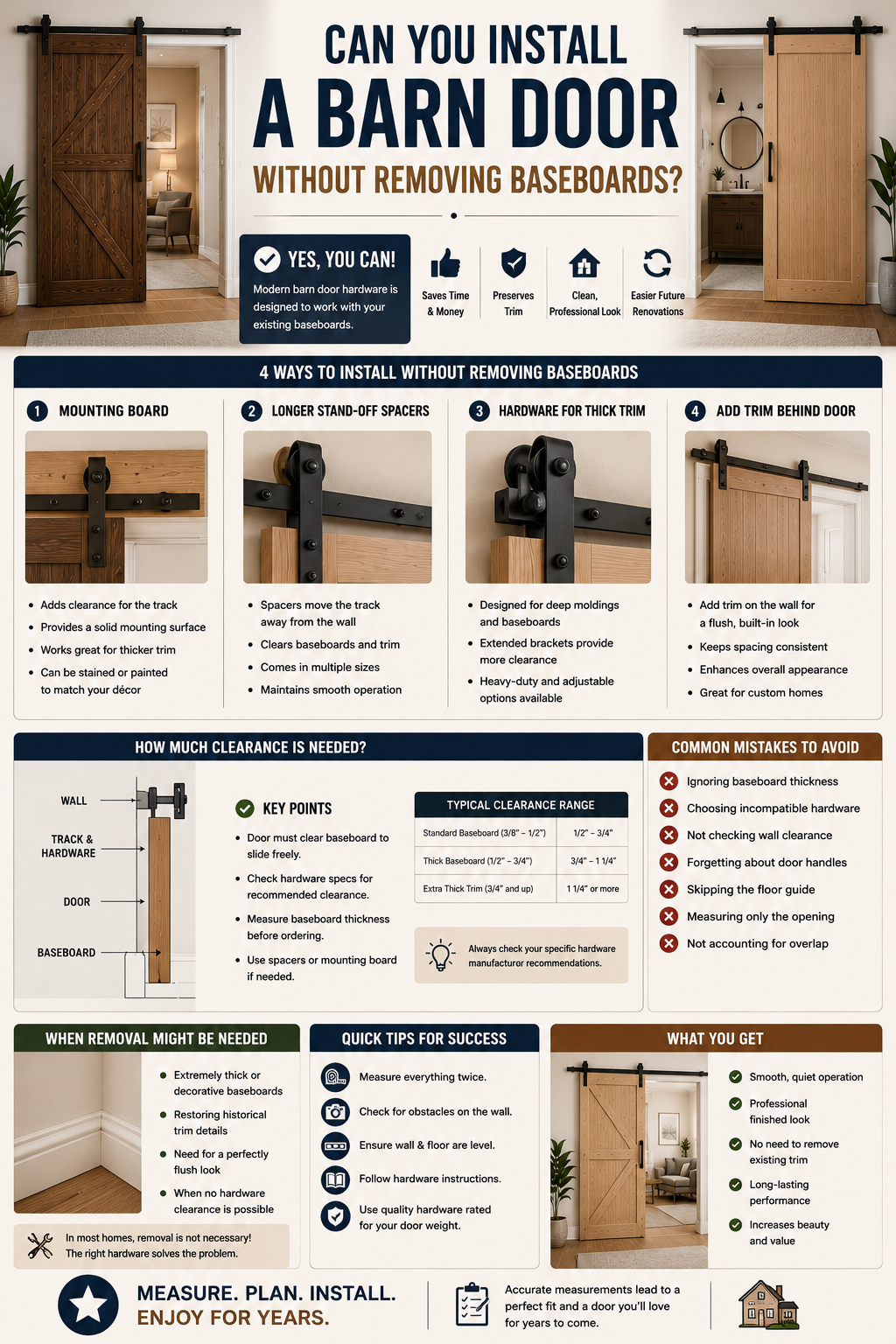
Yes, you can install a barn door without removing baseboards. In fact, many modern barn door installations are designed to work with existing trim. The key is ensuring the door clears the baseboards while still sliding smoothly. This is typically achieved by using spacers, stand-off brackets, or a properly sized mounting board. The best approach depends on the thickness of your baseboards, the type of hardware you choose, and the look you want to achieve.
Why Baseboards Matter
Unlike traditional hinged doors, barn doors slide across the face of the wall.
Because baseboards project away from the wall, they can prevent the door from sitting flat. If the issue isn't addressed, the door may:
Rub against the trim
Lean away from the wall
Leave larger-than-expected gaps
Slide unevenly
Look less polished
Fortunately, these issues are usually easy to solve without removing the baseboards.
Do You Need to Remove Baseboards?
In most situations, no.
Most homeowners leave their existing baseboards in place because it:
Saves time
Reduces labor
Prevents unnecessary wall repairs
Preserves the room's finished appearance
Makes future remodeling easier
Modern barn door hardware is often designed with enough stand-off distance to accommodate standard trim.
Option 1: Install a Mounting Board
One of the most common professional solutions is installing a wooden mounting board above the doorway.
The track is attached to this board instead of directly to the wall.
Benefits include:
Provides additional clearance
Creates a strong mounting surface
Simplifies installation
Works well with thicker trim
Adds a finished architectural detail
Many homeowners paint or stain the mounting board to match either the wall or the barn door.
Option 2: Use Longer Stand-Off Spacers
Many barn door hardware kits include stand-off spacers that position the track away from the wall.
Longer spacers allow the door to clear:
Baseboards
Door casing
Decorative trim
This method maintains smooth operation while keeping the original trim intact.
Option 3: Choose Hardware Designed for Thick Trim
Some premium barn door hardware systems are specifically designed for homes with oversized moldings or decorative baseboards.
These systems often feature:
Extended brackets
Adjustable spacers
Heavy-duty mounting hardware
Increased wall clearance
They're especially useful in older homes with detailed woodwork.
Option 4: Install Matching Trim Behind the Door
In some homes, installers add trim behind the sliding section of the wall so the entire surface remains flush.
This approach:
Creates a more consistent appearance
Helps the door sit evenly
Maintains equal spacing during operation
It's a popular option for custom home projects and higher-end renovations.
When Baseboards Can Cause Problems
Although removal usually isn't necessary, certain situations require additional planning.
These include:
Exceptionally thick baseboards
Decorative crown-style trim
Deep wall molding
Extra-wide door casing
Uneven walls
In these cases, a custom installation solution may be the best option.
How Much Clearance Does a Barn Door Need?
The exact clearance depends on the hardware manufacturer and the thickness of your trim.
Generally, you'll want enough space for the door to:
Slide freely
Avoid rubbing the baseboards
Remain parallel to the wall
Maintain consistent gaps
Checking the hardware specifications before ordering can help prevent installation issues.
Does Leaving Baseboards Affect Privacy?
Not significantly.
Barn doors naturally leave small gaps around the opening because they slide outside the door frame rather than sealing inside it.
Proper sizing and sufficient overlap have a much greater impact on privacy than whether the baseboards remain in place.
If privacy is important, consider:
Choosing a solid wood door
Ordering a custom-sized door
Increasing door overlap
Using quality floor guides
Standard Doors vs Custom Doors
Custom barn doors often make installation around existing trim much easier.
Because they're built to your exact measurements, you can account for:
Baseboard thickness
Door casing
Wall clearance
Hardware placement
Floor height variations
This helps create a cleaner, more built-in appearance.
Common Mistakes to Avoid
Ignoring Baseboard Thickness
Always measure how far the trim projects from the wall before ordering hardware.
Buying Incompatible Hardware
Not every track system provides the same wall clearance.
Confirm that the hardware can accommodate your existing trim.
Forgetting About Door Handles
Some handles protrude farther than expected and may contact the wall if sufficient clearance isn't planned.
Skipping the Floor Guide
A properly installed floor guide helps prevent the door from swinging away from the wall during operation.
Benefits of Keeping Your Baseboards
Leaving the existing baseboards intact offers several advantages:
Faster installation
Less demolition
Lower labor costs
Cleaner project
Preserved trim details
Easier future renovations
For many homeowners, it's the simplest and most practical solution.
Frequently Asked Questions
Can a barn door clear standard baseboards?
Yes. Most modern barn door hardware systems provide enough clearance for standard residential baseboards.
Do I have to cut my baseboards for a barn door?
Usually not. Most installations use mounting boards or stand-off spacers to create the necessary clearance.
Will removing the baseboards make the door fit better?
It can reduce the gap between the door and the wall, but it also requires patching, repainting, or replacing trim. In many cases, leaving the baseboards in place is the more practical choice.
What's the best solution for thick baseboards?
A mounting board combined with quality stand-off hardware is one of the most effective ways to accommodate thicker trim while maintaining smooth operation.
Conclusion
Installing a barn door without removing your baseboards is not only possible—it's the preferred approach for many homeowners and professional installers. With the right hardware, proper measurements, and thoughtful planning, your existing trim can remain in place while your barn door glides smoothly and looks professionally installed.
Whether you're choosing a modern sliding door for a home office or a handcrafted statement piece for your living room, investing in a custom barn door ensures the design fits your space, works with your existing trim, and delivers a beautiful, long-lasting result.
