
Why Your Glass Tank Won't Hold Humidity — and How PVC Fixes It
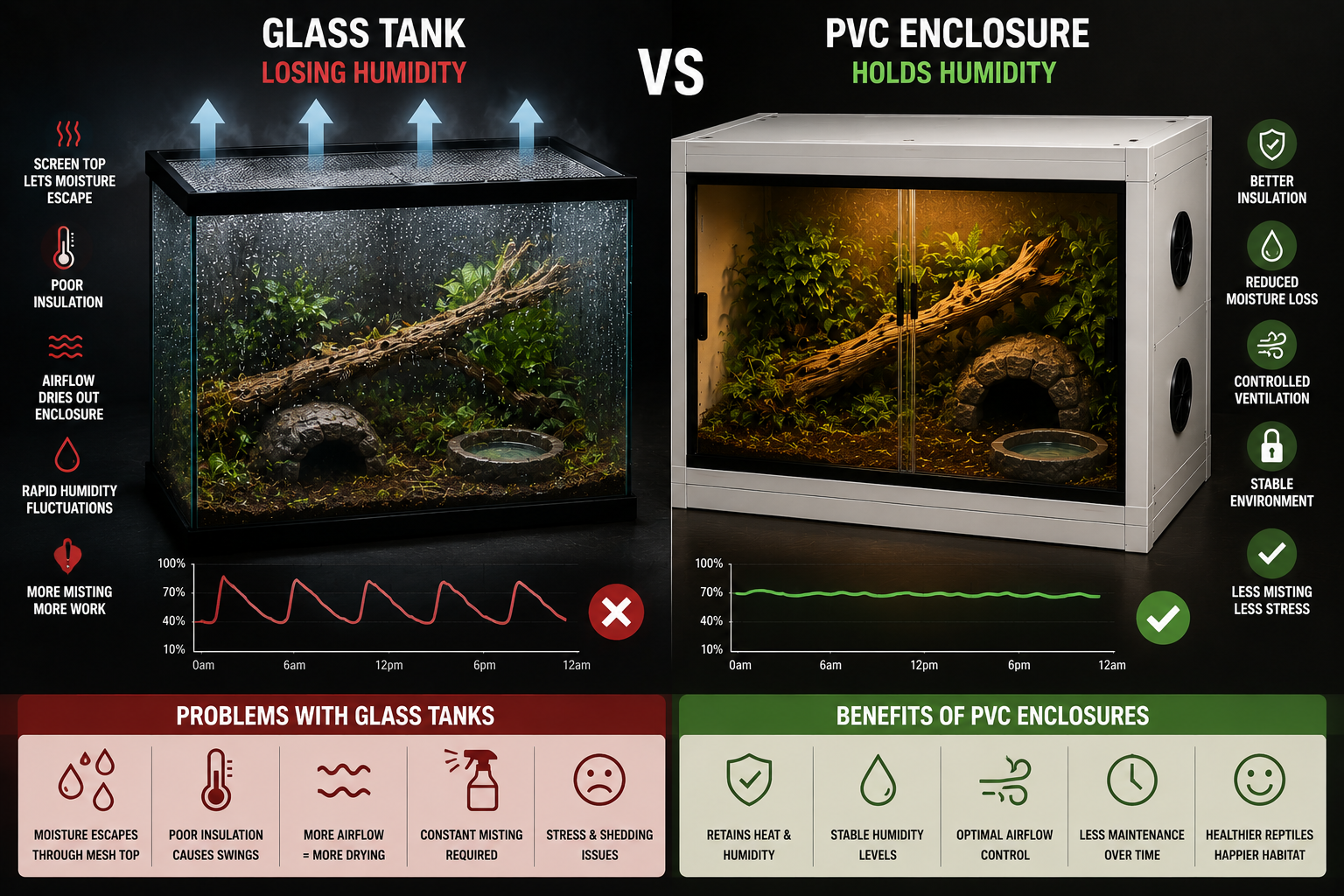
Why Your Glass Tank Won't Hold Humidity — and How PVC Fixes It
If your glass tank constantly loses humidity, the problem usually comes down to poor insulation, excessive ventilation, and rapid moisture loss. PVC reptile enclosures solve these issues by providing better insulation, controlled airflow, and a more enclosed environment that helps retain both heat and humidity.
For many reptile keepers, switching from glass to PVC is one of the easiest ways to achieve more stable environmental conditions.
The Frustration of Chasing Humidity
Many reptile owners experience the same cycle:
Mist the enclosure
Humidity rises temporarily
A few hours later, humidity drops again
Repeat the process
This can become especially frustrating for keepers of tropical and humidity-dependent reptiles.
If you're constantly fighting humidity levels, your enclosure itself may be the problem.
Why Glass Tanks Struggle With Humidity
1. Screen Tops Let Moisture Escape
Most glass reptile tanks include large mesh or screen tops.
While these provide ventilation, they also allow:
Warm air to escape
Moisture to evaporate quickly
Humidity levels to drop rapidly
In many setups, the screen top acts like an open window for humidity.
2. Glass Is a Poor Insulator
Glass loses heat much faster than PVC.
When temperatures fluctuate:
Moisture evaporates unevenly
Humidity becomes unstable
Environmental conditions become harder to maintain
This is one reason glass tanks often require more frequent adjustments.
3. Household Air Conditions Affect Glass More
Glass enclosures are heavily influenced by:
Air conditioning
Ceiling fans
Open windows
Seasonal weather changes
These environmental factors can dry out an enclosure surprisingly quickly.
Signs Your Glass Tank Isn't Holding Humidity
You may notice:
Humidity drops rapidly after misting
Constant need for manual spraying
Dry substrate despite regular watering
Incomplete sheds
Large humidity fluctuations throughout the day
If these issues sound familiar, your enclosure design may be contributing to the problem.
How PVC Fixes the Problem
Better Heat Retention
PVC naturally insulates better than glass.
Benefits include:
More stable temperatures
Reduced heat loss
More consistent environmental conditions
Because temperature and humidity are closely linked, improved insulation often leads to improved humidity stability.
Reduced Moisture Loss
PVC enclosures typically feature:
Solid tops or partially enclosed tops
Smaller ventilation areas
Better-sealed construction
This helps retain moisture for much longer periods.
More Controlled Ventilation
Unlike large screen tops, PVC enclosures usually rely on strategically placed vents.
This allows:
Adequate airflow
Better humidity retention
More stable environmental conditions
You get ventilation without sacrificing moisture.
Less Dependence on Constant Misting
Many keepers find that after switching to PVC:
Humidity stays stable longer
Substrate dries out more slowly
Less frequent misting is needed
The enclosure does more of the work for you.
Reptiles That Benefit Most From PVC Humidity Retention
Ball Pythons
Ball Python
One of the most common reasons ball python owners upgrade to PVC is humidity management.
Boa Constrictors
Boa Constrictor
Benefit from more stable humidity and temperature conditions.
Crested Geckos
Crested Gecko
PVC helps maintain the moisture levels these tropical geckos prefer.
Gargoyle Geckos
Gargoyle Gecko
Stable humidity helps support healthy sheds and overall well-being.
Additional Humidity Tips for PVC Enclosures
Even with PVC, proper setup matters.
Use Moisture-Retaining Substrate
Good options include:
Coconut husk
Cypress mulch
Bioactive soil mixes
Provide a Water Source
Large water bowls contribute to natural evaporation.
Add Plants
Bioactive setups often help stabilize humidity naturally.
Monitor Conditions
Use:
Digital hygrometers
Thermometers
Thermostats
Accurate monitoring helps maintain consistency.
PVC vs Glass: Humidity Comparison
FeaturePVC EnclosureGlass TankHumidity RetentionExcellentModerateHeat RetentionExcellentModerateMoisture LossLowHighEnvironmental StabilityExcellentModerateMaintenance EffortLowerHigher
For humidity-dependent reptiles, the difference can be dramatic.
Is Switching to PVC Worth It?
For many reptile keepers, the answer is yes.
Common benefits include:
Less humidity management
More stable conditions
Reduced maintenance
Better shedding success
Improved overall husbandry
While PVC enclosures usually cost more upfront, many owners find the long-term convenience well worth the investment.
Visual Example
PVC enclosures help create stable, moisture-rich environments that are easier to maintain than many traditional glass setups.
Frequently Asked Questions
Why does my glass tank lose humidity so quickly?
Large screen tops, poor insulation, and excessive airflow are the most common reasons.
Do PVC enclosures really hold humidity better?
Yes. PVC generally retains both heat and moisture more effectively than glass.
Will switching to PVC eliminate the need for misting?
Not always, but many keepers find they need to mist less frequently.
Is PVC better for ball pythons?
Many ball python keepers prefer PVC because it simplifies humidity management.
Are PVC enclosures worth the extra cost?
For humidity-dependent species, many owners feel the improved environmental stability justifies the investment.
Conclusion
If you're constantly battling low humidity in a glass tank, the enclosure itself may be working against you.
Glass tanks often lose moisture through screen tops and poor insulation, making humidity difficult to maintain. PVC enclosures address these issues by retaining heat, reducing moisture loss, and creating a more stable environment.
For reptiles that rely on consistent humidity, switching to a PVC enclosure can make husbandry easier, reduce maintenance, and help create a healthier habitat overall.
