
Custom Cut Lumber vs Big Box Store Boards: Which Is Better?
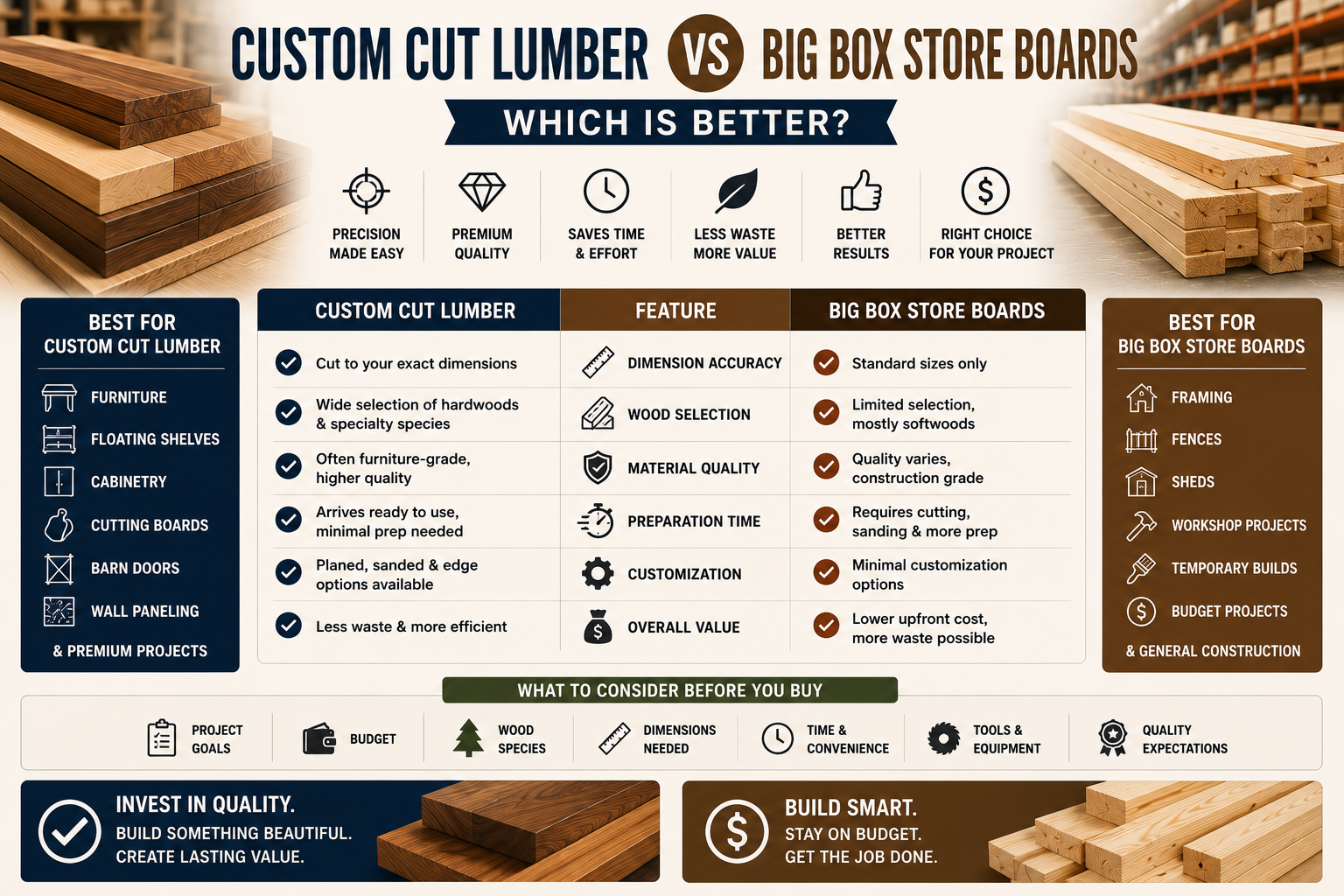
Custom Cut Lumber vs Big Box Store Boards: Which Is Better?
If your project demands precision, premium wood, or a professional finish, custom cut lumber is usually the better investment. Big box store boards are ideal for basic construction, quick repairs, and budget-conscious DIY projects, but they often require additional preparation before they're ready to use. The right choice depends on your project's goals, not simply the price of the lumber.
Why Your Lumber Choice Matters
Every woodworking project starts with one important decision: selecting the right material.
Whether you're building a dining table, floating shelves, custom cabinetry, a butcher block countertop, or a handcrafted barn door, the lumber you buy will influence everything from the build process to the finished appearance.
Many people automatically head to a home improvement store because it's convenient. Others prefer ordering custom cut lumber from a specialty supplier to save time and achieve better results.
Both options have advantages—but they're designed for different types of projects.
What Is Custom Cut Lumber?
Custom cut lumber is wood that has been milled and cut according to your exact specifications before it reaches you.
Instead of purchasing oversized boards and trimming them yourself, you receive lumber that's already prepared for your build.
Depending on the supplier, you may be able to specify:
Exact length
Exact width
Finished thickness
Wood species
Planed surfaces
Sanded faces
Edge profiles
Grain preferences
The goal is to eliminate unnecessary work while improving accuracy.
What Are Big Box Store Boards?
Big box retailers typically sell lumber in standardized dimensions that are intended to suit a wide variety of customers.
You'll commonly find:
Construction lumber
Pine boards
Poplar
Basic oak boards
Plywood
MDF
Melamine panels
Pressure-treated lumber
Because these products are mass stocked, they're generally available for immediate purchase.
Side-by-Side Comparison
FeatureCustom Cut LumberBig Box Store BoardsPrecisionMade to your measurementsStandard dimensionsWood ChoicesExtensive hardwood selectionLimited selectionPreparationReady for useOften requires cutting and sandingAvailabilityBuilt to orderUsually in stockCustomizationHighMinimalBest ForFurniture and premium projectsGeneral DIY and construction
Quality of the Wood
Quality is one of the biggest reasons experienced woodworkers choose specialty lumber suppliers.
Custom lumber providers often focus on carefully selected hardwoods that offer:
Straighter boards
More consistent grain
Better color matching
Improved stability
Furniture-grade quality
Big box stores can certainly stock good lumber, but inventory often varies depending on the location, supplier, and shipment.
That means you may spend extra time sorting through stacks to find the straightest boards.
Precision Saves Time
One overlooked advantage of custom cut lumber is the amount of time it can save.
When your material arrives already cut to the correct dimensions, you can often begin assembly much sooner.
This reduces:
Measuring errors
Cutting mistakes
Material waste
Workshop cleanup
Tool setup time
For professional builders, time savings can be just as valuable as material savings.
More Choices for Premium Projects
If appearance matters, custom lumber suppliers usually offer significantly more options.
Popular hardwoods include:
White Oak
Walnut
Maple
Cherry
Ash
Hickory
Alder
Many suppliers also carry:
Live edge slabs
Wide boards
Thick stock
Specialty hardwoods
These materials are difficult—or sometimes impossible—to find in a typical home improvement store.
Cost: Looking Beyond the Price Tag
Many shoppers compare only the price per board.
However, the total project cost includes much more than the purchase price.
Consider factors such as:
Time spent selecting boards
Fuel for multiple store visits
Tool wear
Material waste
Extra sanding and trimming
Replacement boards if mistakes occur
While custom cut lumber generally has a higher upfront cost, it may reduce overall project time and minimize waste.
Which Projects Benefit Most from Custom Lumber?
Custom cut lumber is an excellent choice for:
Dining tables
Coffee tables
Built-in shelving
Floating shelves
Kitchen cabinetry
Home office furniture
Cutting boards
Window benches
Fireplace mantels
Custom barn doors
Projects like these often require precision and an attractive finish.
When Big Box Lumber Is the Smarter Choice
Standard boards remain an excellent option for many jobs.
Consider them if you're:
Framing interior walls
Building a shed
Constructing a fence
Making workshop storage
Completing temporary projects
Working with a tight budget
For structural work where appearance is less important, standard dimensional lumber is often the practical solution.
Durability Depends on More Than the Store
Many people assume lumber from specialty suppliers automatically lasts longer.
In reality, durability depends on several factors, including:
Wood species
Moisture content
Proper storage
Construction methods
Protective finish
Indoor or outdoor use
High-quality hardwood from either source can perform well when used appropriately.
The difference is that specialty suppliers often provide a broader range of premium materials for projects where appearance and longevity are priorities.
Questions to Ask Before Buying
Before making your purchase, ask yourself:
Does my project require exact dimensions?
Will the wood remain visible after installation?
Do I need premium hardwood?
Can I transport long boards?
Do I have the tools to cut the material accurately?
Is saving time more valuable than saving money?
Your answers will usually point you toward the best option.
Common Buying Mistakes
Avoid these common errors:
Choosing Price Over Quality
The least expensive board isn't always the best value if it requires extensive preparation.
Ignoring Moisture Content
For indoor furniture, kiln-dried lumber is generally the preferred option because it's more stable.
Buying Without a Material List
Know exactly how many boards you need before shopping to reduce unnecessary purchases.
Forgetting About Waste
Every cut creates offcuts. Ordering lumber already cut to size can help reduce leftover material.
Frequently Asked Questions
Is custom cut lumber better than lumber from a home improvement store?
For furniture, cabinetry, and decorative woodworking, custom cut lumber often offers better precision and a wider choice of premium hardwoods. For framing and general repairs, big box store lumber is usually sufficient.
Does custom cut lumber cost more?
Yes, in most cases. However, the additional cost may be offset by reduced waste, less labor, and fewer cutting mistakes.
Can beginners use custom cut lumber?
Absolutely. Many beginners appreciate receiving lumber that's already prepared because it simplifies the building process.
Which option is best for a custom barn door?
A specialty lumber supplier is often the preferred choice because custom barn doors typically require high-quality hardwood, accurate dimensions, and attractive grain patterns.
Conclusion
There isn't a universal winner between custom cut lumber and big box store boards—only the right choice for your project. If you're tackling basic construction or a quick DIY repair, standard boards offer convenience and affordability.
However, for projects where precision, appearance, and craftsmanship matter, custom cut lumber provides clear advantages. From furniture and built-ins to floating shelves and custom barn doors, professionally prepared lumber can save time, reduce waste, and produce results that are built to impress for years to come.
